
Swap vs. Charge: Why Battery Swapping
Is the Backbone of Quick Commerce
If a business promises delivery in 10 minutes, can it really wait hours for a battery to charge?
Think about a delivery rider a few hours into their shift. Orders keep coming in. Then the
battery light turns red. For a normal scooter owner, this is not a big deal — just charge it at
night. But for a quick-commerce business, this is a real problem. That rider and that vehicle
are now stuck doing nothing, right when the business needs them the most.
This is the hidden problem behind fast delivery apps. Everyone wants orders delivered in
minutes. But most EV batteries take 3 to 4 hours to charge fully. So somewhere between the
app and the actual delivery, someone has to solve this gap.
Battery swapping is one way to solve it. In this article, we’ll look at why normal charging
causes problems for busy delivery fleets, how battery swapping works differently, and why it
matters for the business side of things.
Time Is Everything in Quick Commerce
A quick-commerce business is really just a fast delivery business. The whole idea of
“10-minute delivery” affects everything — where warehouses are built, how many riders are
hired, and how vehicles are used.
In this kind of business, an electric scooter is not just a way to travel. It’s a tool that earns
money. The more hours it’s out delivering, the more money it makes for the business. The
more hours it sits parked and charging, the less useful it is.
This is why fleet managers care so much about keeping vehicles on the road. If a vehicle
can only work 6 hours out of a 10-hour shift because it needs 4 hours to charge, that’s a big
loss. Now imagine this happening across 100 or 1,000 vehicles. That adds up to a lot of
missed deliveries.
This problem gets worse during busy hours, like lunch or dinner time. That’s exactly when
the business needs every vehicle working. But that’s also when a rider’s battery is most likely
to run low.
Why Normal Charging Doesn’t Work Well for Busy
Delivery Fleets
To be fair, normal charging isn’t bad. If a vehicle is used for daily commuting and parked
overnight, plug-in charging works just fine.But delivery fleets don’t work like that. Here’s why normal charging causes problems for
them:
Charging takes too long. A full charge can take several hours. But delivery orders don’t
stop for hours at a time. Riders need to be available all day, in short bursts, not in one long
break.
You can’t always plan around busy hours. Fleet managers would love to charge vehicles
only during quiet hours. But delivery demand can spike suddenly, and there may not be
enough charged vehicles ready.
Charging points create long queues. When many riders come back to charge at the same
time, they end up waiting in line. That’s time the rider could have used to complete more
deliveries.
Small delays add up fast. One vehicle waiting to charge isn’t a big deal. But twenty
vehicles waiting during a Friday evening rush becomes a real problem — the business
simply can’t deliver as many orders.
This doesn’t mean charging stations have no place in EV fleets. It just means that for a
business built on speed, waiting hours to charge doesn’t fit well.
What Is Battery Swapping? A Simple Explanation
Battery swapping solves this problem in a different way. Instead of waiting for a battery to
charge, the rider simply swaps the empty battery for a fully charged one.
Here’s how it works:
The rider rides to a battery-swapping station
They remove the empty battery
They pick up a battery that’s already charged
They’re back on the road in just a few minutes
The main difference is simple:
Charging makes the vehicle wait for power. Swapping brings ready power straight to
the vehicle.
This small difference makes a big impact. With charging, how long a vehicle can work
depends on how long its own battery takes to fill up. With swapping, it only depends on how
close the nearest swap station is. For a business where every minute matters, that
difference is huge.
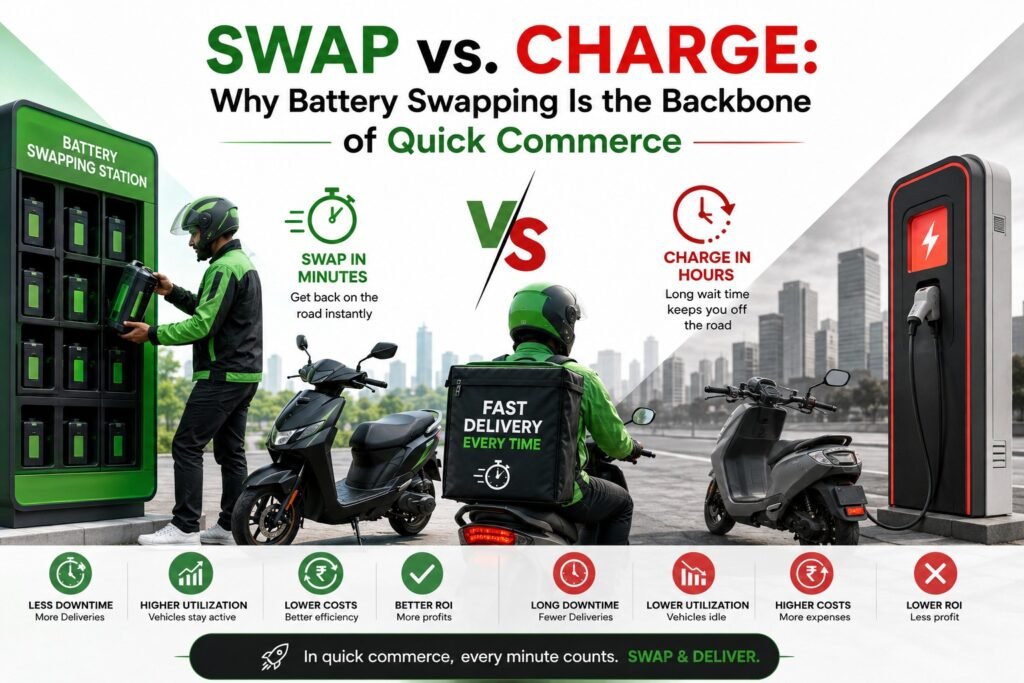
Swap vs. Charge: A Simple Comparison
Factor | Charging | Battery Swapping |
Time needed | 3–4+ hours for full charge | A few seconds |
Vehicle downtime | High, especially during busy hours | Very low |
Fleet usage | Lower, due to charging breaks | Higher, vehicles stay active |
Good for non-stop work | Not ideal | Built for it |
Handling busy hours | Struggles with sudden demand | Handles it easily |
Predictability | Can be disrupted by queues | Easy to plan around |
Range anxiety | Higher | Lower |
Growing the fleet | Needs more chargers and time | Needs more stations and batteries |
This doesn’t mean swapping is always better in every situation. A small fleet with plenty of
idle time may do fine with regular charging. But for busy delivery fleets that run non-stop,
swapping usually works better.
How Battery Swapping Reduces Range Anxiety
For regular EV users,
“range anxiety” usually means worrying about reaching home before
the battery dies. For a fleet manager, it means something bigger.
It shows up as questions like: Will this vehicle have enough charge to finish the next few
deliveries? What if the battery runs low during a busy hour? How much time will the rider
lose waiting to charge? And how many extra vehicles does the business need just to make
up for the ones stuck charging?
That last point is often overlooked. Many fleets buy extra vehicles just to cover for the ones
sitting idle at charging points. That’s extra money spent just to fix a charging problem.
With a reliable battery-swapping network, this changes. Instead of watching the battery
percentage and worrying, riders simply ask: “Where’s the nearest swap station?” That’s a
much easier question to plan around.
The Real Cost of DowntimeThe cost of charging delays isn’t just about electricity. It shows up in other ways too — fewer
deliveries completed each day, lower rider productivity, poor use of vehicles, and the need to
buy extra vehicles as backup.
There’s also a hidden cost. Busy times — festivals, weekends, or sudden spikes in orders —
are exactly when a delivery business can earn the most. If many vehicles are stuck charging
during these hours, the business isn’t just losing efficiency. It’s losing money it could have
earned.
So the real question isn’t “how much does charging cost?” It’s “how much does it
cost when a vehicle can’t work?” Electricity is a small expense. Lost deliveries during
busy hours often cost much more, even if it’s harder to see that on paper.
Why Battery Swapping Fits Quick Commerce So Well
Quick commerce runs on speed, high vehicle usage, predictable operations, and almost no
downtime. Its whole advantage comes from being faster and more reliable than other
options.
Battery swapping follows the same idea — cut down waiting time wherever possible. A
business built to deliver orders in minutes naturally works well with an energy system built to
get vehicles back on the road in minutes too. The two ideas share the same goal.
Where Speedforce EV Comes In
This is where a network like Speedforce EV’s battery-swapping stations becomes useful —
not as a sales pitch, but as a real solution to the problem this article has been talking about.
Delivery fleets don’t just need a place to charge. They need a way to keep vehicles moving
through busy, unpredictable hours — which is exactly what quick commerce deals with every
day. Speedforce EV focuses on that need: giving fleet operators access to charged batteries
whenever and wherever riders need them, instead of making vehicles sit and wait.
The real value isn’t in one single feature. It’s the idea that EV infrastructure for delivery fleets
should match how these businesses actually work. For quick commerce, that means less
downtime, faster turnaround between deliveries, and a more predictable way to manage
energy needs.
Looking Ahead
As quick commerce keeps pushing delivery times lower, the supporting infrastructure needs
to keep up. A 10-minute delivery business can’t run smoothly on an energy system that
needs hours to recharge.
That’s really what this whole discussion comes down to. Charging works well for many EV
users. But for a business built on speed and constant availability, waiting hours to charge
just doesn’t fit.Battery swapping doesn’t solve every challenge of running an electric fleet. But for delivery
businesses where downtime means lost orders and lost money, it solves one of the biggest
problems — turning hours of waiting into minutes of swapping.
For fleet operators looking to grow their delivery business without slowing it down, this is
worth exploring. Speedforce EV’s battery-swapping stations are built around one simple goal
— keeping fleets moving, not waiting.