

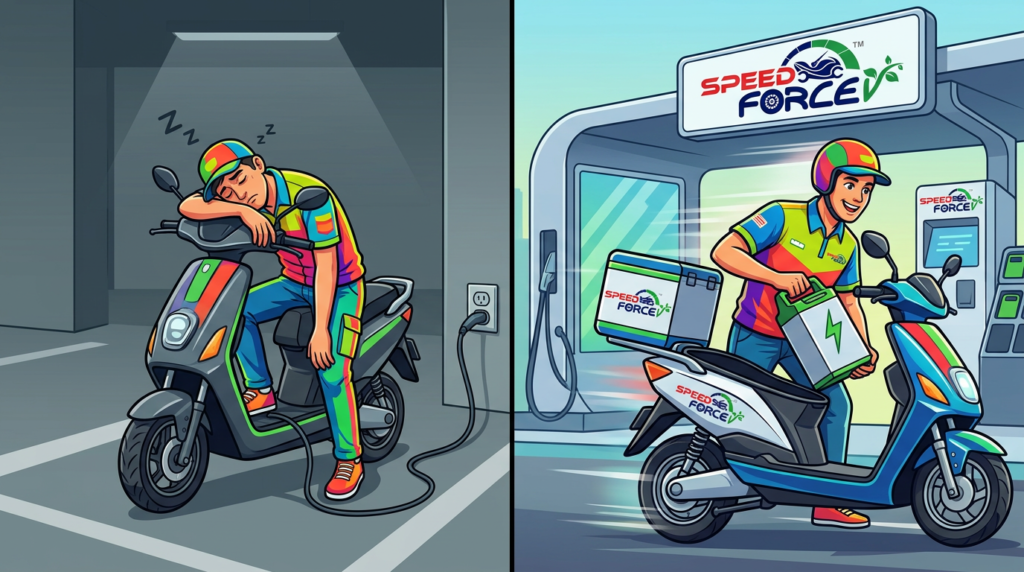
In the world of logistics and last-mile delivery, there is one metric that rules them all: Uptime.
If your wheels aren’t turning, they aren’t earning. For years, the narrative around Electric Vehicles (EVs) has been dominated by “Fast Charging.” But as fleet managers scale their operations, they are hitting a harsh reality: Traditional charging is a bottleneck that is bleeding their bottom line.
At SpeedForce EV, we’ve seen the shift firsthand. Smart fleets are no longer waiting for a charge; they are choosing to swap. Here’s why charging might be killing your uptime and how swapping is the antidote.
1. The “Waiting Room” Problem
Even with the fastest DC chargers, a typical commercial EV takes 45 to 90 minutes to reach a functional charge level. For a delivery driver on a tight schedule, that’s not just a break; it’s a lost shift.
- Charging: 60+ minutes of idle time per cycle.
- Swapping: Under 5 minutes. With battery swapping, your vehicle is back on the road in the time it takes to grab a cup of coffee. You aren’t just saving time; you’re gaining back hours of operational productivity every single day.
2. The Hidden Cost of Battery Degradation
Rapidly “fast-charging” a battery every day is like running a marathon at a full sprint eventually, the heart gives out. Frequent fast-charging generates heat that accelerates battery degradation, leading to a shorter lifespan and reduced range over time.
When you choose a Battery-as-a-Service (BaaS) model through swapping, the health of the battery is no longer your headache. Batteries are charged in controlled, cooled environments at swapping stations, ensuring peak performance and longevity without the fleet owner carrying the risk of a dying asset.
3. Slashing Upfront Capital (CapEx)
The most expensive part of an EV is the battery, often accounting for 30% to 40% of the vehicle’s total cost. Buying a fleet with fixed batteries ties up massive amounts of capital.
Smart fleets use swapping to “decouple” the battery from the vehicle. By purchasing the vehicle shell and subscribing to a swapping network, fleet owners can:
- Lower their initial investment by nearly 40%.
- Expand their fleet size with the same budget.
- Convert a massive upfront cost into a predictable, monthly operating expense (OpEx).
4. Real Estate and Grid Constraints
Setting up a charging hub for 50 vehicles requires massive space and a heavy-duty electrical grid connection. In congested urban areas, finding that kind of real estate is nearly impossible.
Swapping stations are modular and compact. A single swapping station can service significantly more vehicles per day than a row of chargers because the “turnover” is instant. It’s the difference between a parking lot and a pit stop.
The Bottom Line
If your fleet is tethered to a wall for 3 hours a day, you aren’t running a modern logistics business, you’re running a waiting room. Uptime is your most valuable asset.
At SpeedForce EV, we are committed to keeping India’s two-wheeler fleets in constant motion. By choosing swapping over charging, you aren’t just choosing a technology; you’re choosing a competitive advantage.
Don’t let your revenue sit idle. Switch to the speed of swapping.
Ready to optimize your fleet?Contact SpeedForce EV today to learn how our infrastructure can power your business into the future.